




Albert Einstein was once asked to explain the concept ofrelativity. His response was: “Put your hand on a hot stove for a minute, andit seems like an hour. Chat with an interesting person for an hour, and itseems like a minute. That’s what relative means”.
Today, many market participants describe interest rates as "high." But isn't that simply a matter of perspective?
In the early 1980s, the yield on the 10-year U.S. Treasurybriefly approached 16%. In contrast, it fell to roughly 0.5% during thepandemic-era lows of the early 2020s. One extreme could certainly be consideredunusually high, and the other exceptionally low. Against that backdrop, today'srate of about 5.25% may look much closer to normal.
Perhaps the best way to answer whether rates are truly highis to look at how consumers and businesses are behaving. If borrowing costswere severely restricting economic activity, we would expect to see lending andinvestment slow significantly.
Instead, despite a sluggish housing market, businesses continue to borrow and invest, helping support overall economic growth. In this newsletter, we highlight an important but often overlooked trend: banks are still lending, and companies are still taking out loans to finance expansion, equipment purchases, and future growth.
Businesses Remain Confident
Companies are continuing to borrow money to fund technologyupgrades, equipment purchases, infrastructure projects, and business expansion.Demand for business loans has increased across companies of all sizes,suggesting that many business leaders still see opportunities for growthdespite ongoing economic uncertainty.
Banks Are Still Open for Business
Unlike periods leading up to recessions, banks are notsignificantly tightening lending standards. In fact, some smaller banks havemade borrowing easier, and competition among lenders is helping keep financingavailable.
This is a positive sign because lending and investment oftengo hand-in-hand with business growth, hiring, and future economic activity.
Borrowing Costs Are Improving
Interest rates remain relatively high compared with the lastdecade, but businesses are benefiting from better loan terms and increasedcompetition among banks. As a result, borrowing is not as restrictive as manyexpected.
Housing Remains a Weak Spot
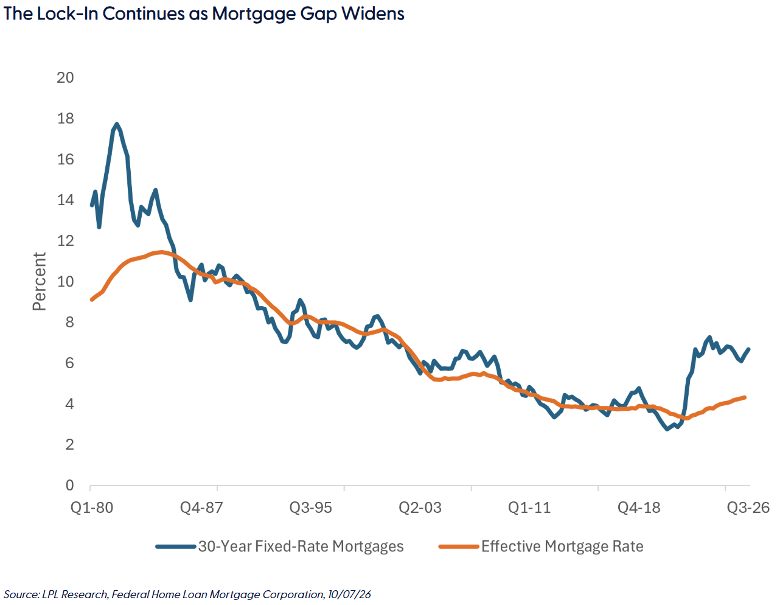
The housing market tells a different story. Mortgage ratesrecently rose above 7%, making home purchases less affordable. At the sametime, many homeowners have older mortgages with much lower rates and arereluctant to sell their homes and take on a higher-rate loan.
This has created a "lock-in" effect that limits the number of existing homes available for sale. As a result, housing activity remains subdued and is expected to be a modest drag on economic growth this year.
Investor Takeaway
A healthy flow of credit is often a good sign for economicgrowth. Businesses are continuing to invest in their future, which can supportcorporate earnings and economic activity even while housing remainsconstrained. Although risks remain, current lending trends provide a reassuringsignal that many companies still see opportunities ahead.
Bottom Line
Housing remains stuck, but businesses are still borrowing,investing, and expanding. As long as companies continue putting capital towork, the economy has an important source of support that can help sustaingrowth through the coming year.
Read the full commentary: Credit Is Still Flowing, and Businesses Are Borrowing
.gif)

.png)

.png)